Problem Statement: Insights Without Action
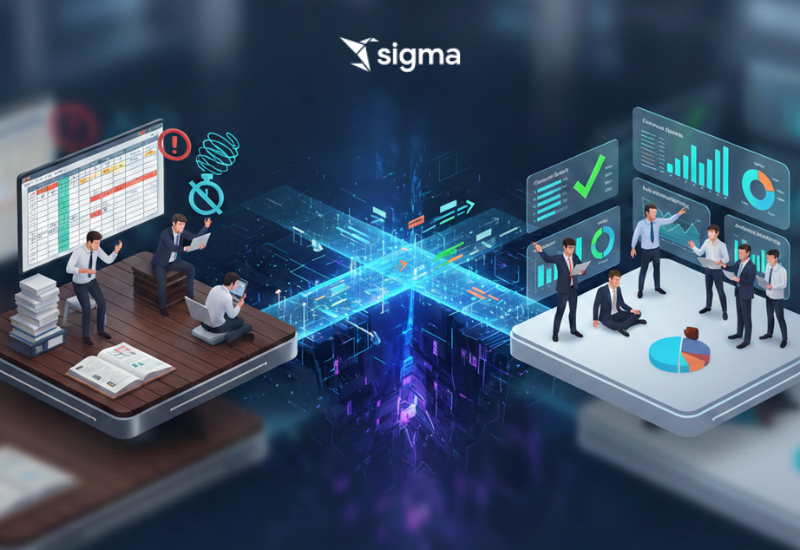
Finance and operations teams invest heavily in analytics to understand performance, risks, and opportunities. Yet in most organizations, analytics still ends at insight consumption. Dashboards surface variances, exceptions and threshold breaches—but the path from insight to action remains manual and fragmented.
Typical challenges include:
- Users identify an issue in a dashboard, then switch tools to email, Slack, or ticketing systems
- Approvals for budget changes, accruals or exceptions happen outside the analytics platform
- Alerts are rule-based but lack context, forcing users to re-analyze data elsewhere
- Critical actions depend on human follow-ups, creating delays and missed opportunities
This creates an insight-to-action gap. Business users can see the problem but cannot act on it where the data lives. As a result, decisions slow down, accountability is diluted and analytics becomes reactive rather than operational.
Modern finance teams need analytics that not only explains what happened but also enables what should happen next—immediately, securely and within governed workflows.
Solution: Sigma Workflow & Alerts
Overview
Sigma Computing closes this gap through Workflows, Alerts and Actions, enabling organizations to trigger notifications, approvals and downstream actions directly from analytics. Instead of dashboards being the final destination, Sigma transforms them into decision-driven applications.
With Sigma Workflow:
- Insights automatically trigger alerts when thresholds are breached
- Business users initiate approvals and actions from within dashboards
- Multi-step workflows execute without leaving Sigma
- Analytics connect to downstream systems through APIs and governed data write-backs
This capability turns Sigma from a reporting tool into an operational analytics platform, where data drives action in real time.
How It Works
The Foundation: Sigma Actions
At the core of workflows and alerts is Sigma’s Actions framework. Actions define what should happen when a user clicks a button, a condition is met, or a threshold is exceeded.
Actions can:
- Send notifications (Email, Slack, Teams)
- Trigger approval workflows
- Write updates back to the data warehouse
- Call external services through HTTP APIs
- Execute conditional, multi-step logic
These actions are configured once and reused across workbooks, dashboards and data apps.
Alerts: Proactive, Context-Aware Notifications
Sigma alerts are data-driven and context-rich, originating directly from live analytics. Finance teams can define alert conditions on governed metrics—such as budget variance, opening balance changes or payment risk—and automatically distribute insights through Email or Slack.

Alerts can be:
- Time-based (daily, weekly, month-end)
- Conditional (only trigger when a threshold is breached)
- Context-aware (delivering the exact page, filters, and metrics)
Instead of users checking dashboards, insights are delivered proactively in the communication channels where decisions already happen.
Workflows: From Insight to Approval
Sigma workflow turn dashboards into guided decision paths, eliminating the manual handoffs that slow finance operations.

When insights require action, users can trigger approvals, notify stakeholders, or distribute validated reports directly from a dashboard.
For example:
- A requisition spike triggers a scheduled approval report
- The right approvers receive a formatted PDF at a defined cadence
- Decisions happen with a shared, governed view of the data
All actions are orchestrated inside Sigma, reducing reliance on emails, spreadsheets and disconnected tools.
External Integrations: Beyond Sigma
Sigma extends analytics into enterprise workflows through native integrations and API-based actions. Insights can be delivered into collaboration tools such as Slack or written back to the cloud data warehouse to trigger downstream processes.

This enables:
- Automated executive and operational reporting
- Exception notifications in operational channels
- Consistent distribution of certified numbers
Sigma becomes the connective layer between insight and execution, ensuring analytics informs real business activity without forcing users to leave their daily tools.
Key Benefits of workflow automation
For Finance & Business Teams
- Faster Decisions: Act on insights the moment they appear
- Reduced Manual Effort: No emails, exports, or follow-ups
- Accountability: Clear ownership through approvals and audit trails
- Confidence: Decisions are made with live, governed data
For IT & Analytics Teams
- Less Tool Sprawl: One platform instead of multiple workflow tools
- Governed Automation: Actions inherit warehouse security and permissions
- Reusability: Centralized workflows used across multiple dashboards
- Lower Support Burden: Fewer ad-hoc requests and manual interventions
For the Organization
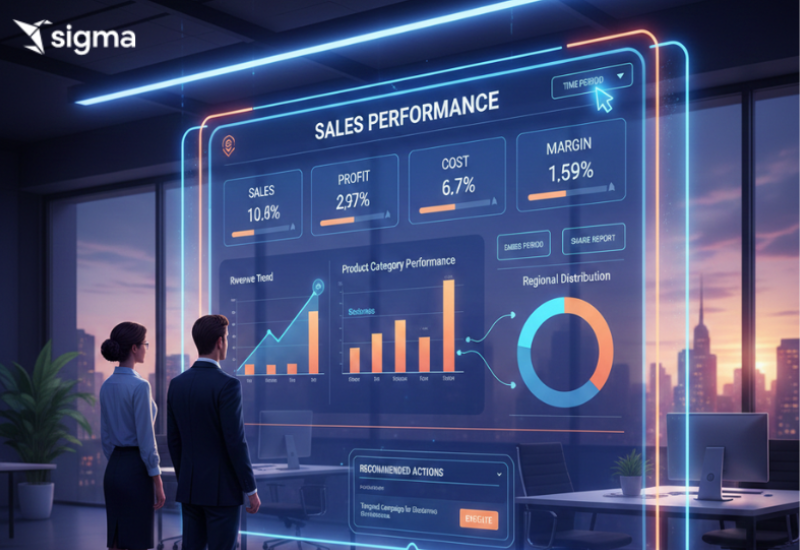
- Operational Analytics: Dashboards become action-oriented applications
- Consistency: Standardized processes for approvals and alerts
- Speed at Scale: Enterprise workflows without custom development
- Better ROI on Analytics: Insights directly tied to outcomes
Sigma workflow operate within the same enterprise-grade governance model:
- Role-based access controls define who can trigger actions
- Row-level and column-level security ensure users act only on permitted data
- Warehouse permissions govern write-back and updates
- Activity logs capture every action, approval and alert trigger
This ensures workflow automation without compromising control.
Why This Matters for Dataplatr Clients
At Dataplatr, we help organizations move beyond dashboards to decision-centric analytics. By combining Sigma’s workflow and alerting capabilities with our finance accelerators and governed sigma data models, we enable:
- Faster close cycles
- Real-time exception management
- Finance-owned processes without IT bottlenecks
- Analytics that drive measurable business outcomes
Sigma provides the platform. Dataplatr delivers the architecture, accelerators and industry expertise to operationalize it at scale.
Conclusion
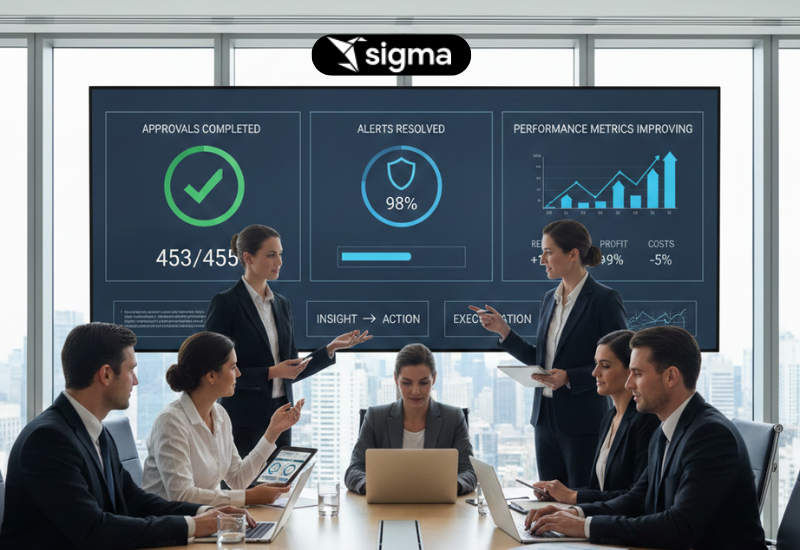
Sigma Workflow and Alerts eliminate the final gap in analytics: execution. By embedding approvals, notifications and system integrations directly into dashboards, Sigma ensures that insights do not stop at observation—they result in action.
For organizations looking to modernize finance and operational decision-making, this capability transforms analytics from a passive reporting layer into an active business engine. With Sigma and Dataplatr together, insights become outcomes—faster, governed and at enterprise scale.